
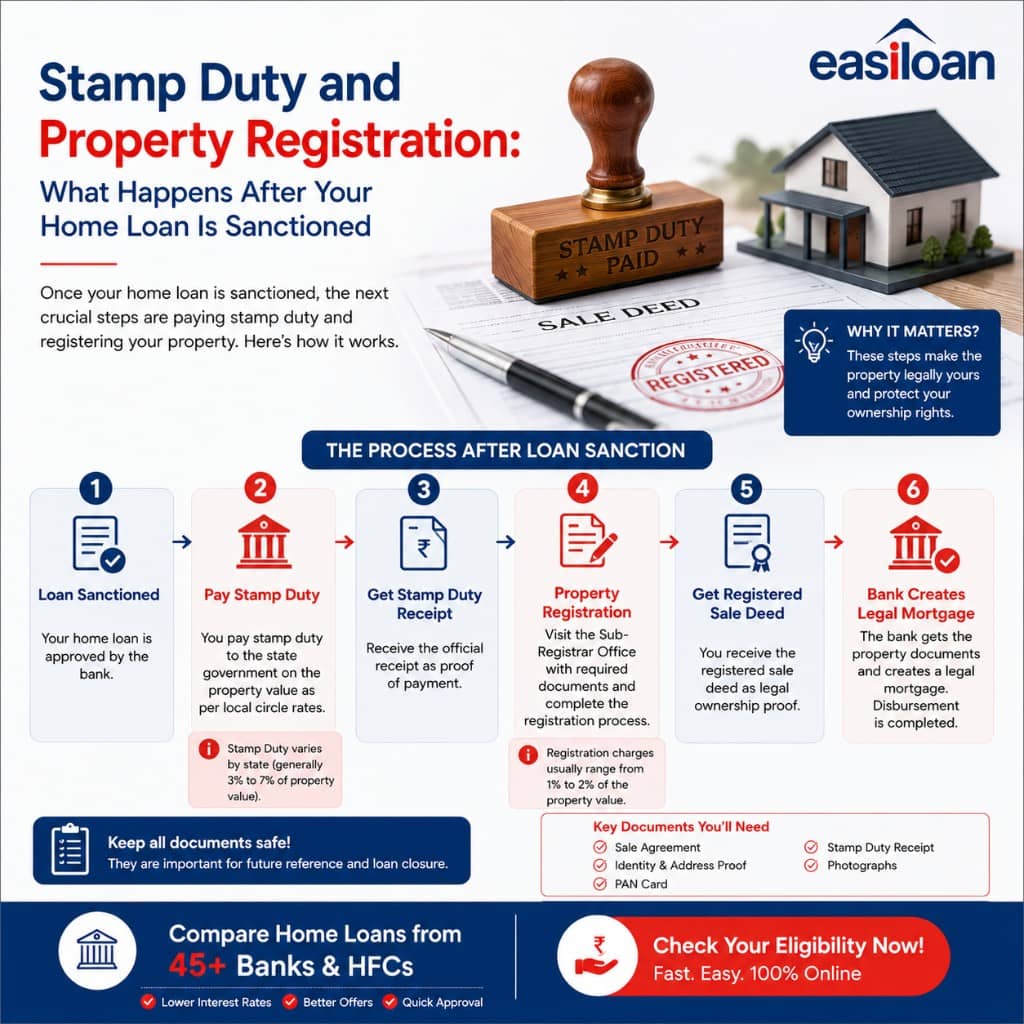
Where Registration Fits in the Home Loan Timeline
Stamp duty payment and property registration typically happen around the time of disbursement, since many lenders require the sale deed to be registered (or the process to be underway) before releasing funds for a resale property. For under-construction properties, registration timing depends on the builder agreement and state-specific rules, and can happen at booking, at possession, or in some states, at both stages.
What Is Stamp Duty and Who Pays It?
Stamp duty is a state government levy on property transactions, calculated as a percentage of the property's sale value or the government-assessed 'ready reckoner' value, whichever is higher. It is paid by the buyer, and rates vary significantly by state — typically ranging from around 3% to 7% of property value, with some states offering concessions for women buyers.
Registration Charges
In addition to stamp duty, registration charges (usually a smaller percentage, often around 1%, subject to state-specific caps) are paid to register the sale deed with the sub-registrar's office. Together, stamp duty and registration charges form a meaningful upfront cost that buyers should budget for separately from the loan-financed property value, since lenders generally do not finance these charges as part of the loan amount.
Documents Needed for Registration
- Sale deed drafted and vetted (often by the lender's or buyer's legal counsel)
- Identity and address proof of buyer and seller
- PAN cards of all parties
- Property card / 7-12 extract or equivalent land record document, depending on state
- NOC from society or builder, where applicable
- Proof of stamp duty and registration fee payment
- Passport-size photographs of buyer and seller for the registrar's records
How the Lender Is Involved
Since the property secures the loan, lenders often require the registered sale deed (or evidence that registration is underway) before final disbursement for resale properties. Some lenders' representatives accompany the buyer to the sub-registrar's office, particularly when large loan amounts are involved, to ensure the mortgage or charge is properly recorded alongside the ownership transfer.
Budgeting for These Costs
Because stamp duty and registration charges are paid out of pocket rather than financed, they can add a significant amount — often several lakh rupees on a mid-sized urban property — on top of your down payment. It's worth factoring this into your overall savings plan well before you finalize a property, rather than discovering the gap at the registration stage.
Frequently Asked Questions
Does the home loan amount include stamp duty and registration charges?▾
Generally no — most lenders finance only the property's sale value up to a certain loan-to-value ratio, and stamp duty plus registration charges are expected to be paid by the buyer separately.
How is stamp duty calculated if the sale price differs from the government-assessed value?▾
Stamp duty is typically charged on whichever is higher — the actual transaction value or the government's ready reckoner/circle rate valuation for that property.
Are there any concessions on stamp duty?▾
Several states offer reduced stamp duty rates for women buyers or joint ownership with a woman co-owner, though the exact concession and eligibility rules vary by state.
When exactly does registration happen for an under-construction property?▾
This depends on state rules and the builder agreement — some states require registration of the agreement for sale at booking, with a final conveyance deed registered at possession, while practices differ elsewhere.
Can EasiLoan help me estimate total upfront costs including stamp duty?▾
Yes — EasiLoan's advisory team can help you factor in stamp duty, registration, and other upfront costs alongside your down payment, so your overall budget reflects the true cost of the purchase, not just the loan amount.
Disclaimer: EasiLoan is a home loan advisory and comparison platform, not a direct lender. Information on this page is for general guidance only and does not constitute financial advice. Loan approval, interest rates, and documentation requirements vary by lender and are subject to individual eligibility and lender policy. Please consult an EasiLoan advisor or your chosen lender for details specific to your application.